


I wrote this series about a year ago, prior to joining Art of Problem Solving as the VP of Beast Academy. At the time, I was working full time on my passion project, Puzz, creating critical thinking games for kids. There’s probably a reason AoPS feels like coming home! A year later, even with a new role, and unprecedented evolution in what AI is capable of, my overall theses still feel relevant. However, with even more scrutiny on AI and screen time (hello, Toy Story 5, and screen time bans in schools) revisiting and sharing this series felt timely and important.
The goal of this series is to share my point of view around what matters most while raising kids in the age of AI, and what we as parents might do about it.
Part 3: The skills that matter, and how to build them
Part 1: The building blocks of critical thinking | Part 2: Critical thinking: why it matters. Why we're not ready
Confession time: I started this post thinking I'd crowdsource brilliant tactics for building critical thinking in the AI era. If I'm being honest, I was really just fishing for ideas for what to do with my own kids.
But I was surprised. There's not a lot out there.
I ran a few polls. Most of the responses were some version of "great question - please share what you learn." I became that annoying person who hijacked conversations with "So.. how are you preparing your kids for an AI future?" (Apologies, friends!)
Mostly, the answers fell into two camps:
- Waiting and seeing: Translation: "I have no idea. I'm burying my head in the sand until things settle".
- Deciding on exposure: How much AI should kids use, and when? This usually drifted into familiar screen time and social media debates.
When I wrote this last year, there was almost nothing beyond that. Today, there’s only slightly more.
To be fair, it's still early. No one knows exactly what the future will look like, much less how to prepare our kids for it. But after digging into articles, podcasts, and going down a variety of other rabbit holes, I did find some parents wrestling with the same thing. And like me, they were hearing the same answers from their circles. In particular, Jason Weeby's post on this topic resonated.
Among this group, while there's little clarity right now on tactics to prepare kids, there's at least some growing consensus on which skills will matter.
The skills that keep coming up
Empathy & connection
This may be the most important skill. One line that stuck with me: "AI can recognize emotions, but can't actually feel them." Feeling is uniquely human. It's also what I look for when hiring Product Managers. If you can truly empathize with customers' pain, you'll build better solutions. As Jason said: "If simply being relational is powerful in the age of AI, being able to relate to lots of different people is a superpower."
At home, we've started a dinnertime ritual: sharing one moment where we built a connection, and one thing we could have done to better build connection.
(Sidenote: "Junior Bake Off" on Netflix is surprisingly great for role modeling both empathy and connection)
Adaptability & resilience
The pace of change is unprecedented. Mustafa Suleyman, CEO of Microsoft AI and author of The Coming Wave: AI, Power, and Our Future, points out that shifts that once took generations now play out in just 2-5 years. The ground rules are changing while we're playing the game. We need to give kids the tools to adapt, adjust, and bounce back when the plan no longer works.
With two kids who thrive on routine, we get daily (painful) practice at this. Ice cream shop out of strawberry? That's a meltdown waiting to happen. But if today they can learn to roll with chocolate instead, maybe down the road they'll be equipped to roll with the very model of "success" changing day by day.
Staying connected to the physical
Ironically, AI might push us back to basics. More parents - and even Gen Z kids - are rediscovering the value of physical skills because they're harder to automate away. An early engineer at a large tech company even told me that computer programming won't be a useful skill anymore, so he went back to law school. I'm not sure I fully buy the doom loop narrative of “AI is killing x job” , but I do see the value in creating, building, and fixing in the real world. My 4 year old might be on to something with his dreams of becoming a garbage truck man. At the very least, maybe it's time to bring back Woodshop and Home Economics.
A strong sense of values
When kids are drowning in information, they need an inner compass. What do they stand for? What matters to them? What do they believe? That sense of self keeps them from drifting in a sea of inputs or getting stuck in echo chambers.
Questions are great for this. Question assumptions, question why. A question framework I particularly like: the THINK framework my daughter's school uses. It's meant for conversations, but works just as well for information in the AI era. Is it True? Helpful? Inspiring? Necessary? Kind?
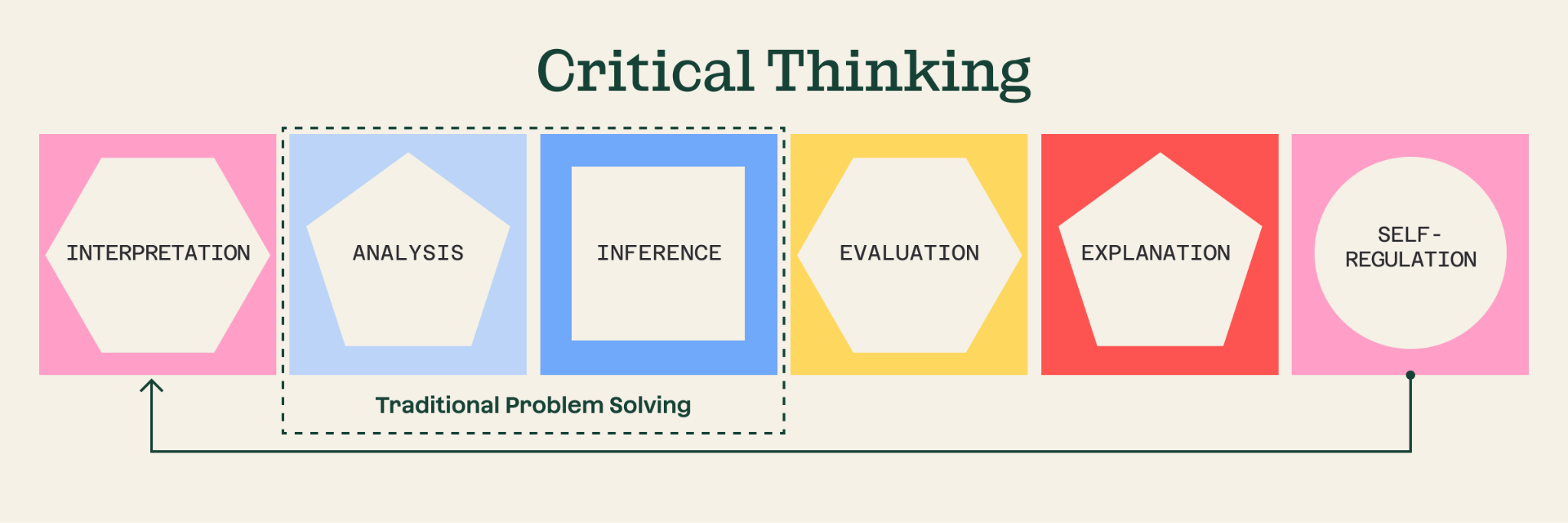
Critical thinking
You probably knew this was coming, especially since it's why I’m at AoPS. I was glad to see that this was on everyone's list. We'll talk more about this in the next section.
Creativity surprisingly turned out to be a wild card. Some say AI makes it less important; others say it makes it more critical. I suspect it depends on how they define it. If defined by outputs (e.g. writing, pictures, designs), AI is great at replicating and remixing. But if you see it as imagination and divergent thinking, it feels more important than ever, and closely tied to critical thinking and empathy.
OK, but can we teach critical thinking?
If there aren't many AI-era guides, we can at least learn from decades of trying.
Researcher Daniel Willingham points out that the biggest challenge in teaching critical thinking is transferability, the ability to apply a skill from one context to another. Breaking problems down in math class doesn't mean you'll be able to break down problems at work.
Critical thinking isn't plug-and-play. It's deeply tied to domain knowledge. Still, Willingham argues that although metacognitive strategies are insufficient without domain knowledge, they're still necessary. Two things help with transferability:
- Familiarity with a problem's deep structure
- Knowing to look for deep structure in the first place
That familiarity comes from repeated exposure to one type of problem and seeing the same structure across very different contexts. For what it's worth, this was basically McKinsey's playbook to train associates. It's also the point of Beast Academy - repeatedly expose kids to problem structures in a way that feels fun.
So, yes – critical thinking has been hard to teach. But no, it's not impossible. We need to give kids the tools and opportunities to identify and apply problem structures by asking good questions, arriving at and testing answers, and checking their assumptions.
Wrapping Up
While many parents are debating the important question of whether and how to let their kids use Claude or ChatGPT, fewer are asking: what skills will actually matter when they grow up, and how do we build these now?
Critical thinking is near the top of that list. Maybe I'm overly optimistic, but I think that the human ability to wander off on divergent tangents, explore "what ifs" and search for global maxima combined with AI's horsepower and context, could unlock magic.
Our job as parents isn't to teach kids to outpace machines. It's to raise kids who don't just take answers at face value, but can think, probe, and steer the machines towards something better.