


I wrote this series about a year ago, prior to joining Art of Problem Solving as the VP of Beast Academy. At the time, I was working full time on my passion project, Puzz, creating critical thinking games for kids. There’s probably a reason AoPS feels like coming home! A year later, even with a new role, and unprecedented evolution in what AI is capable of, my overall theses still feel relevant. However, with even more scrutiny on AI and screen time (hello, Toy Story 5, and screen time bans in schools) revisiting and sharing this series felt timely and important.
The goal of this series is to share my point of view around what matters most while raising kids in the age of AI, and what we as parents might do about it.
Part 2: Critical thinking: why it's important and why we're not ready
Part 1: The building blocks of critical thinking
It's always been important
A while back, my then 6-year-old was in the backseat, deep in a Puzz Dots match against the app.
She narrated her possible moves: "If I go here, Puzz gets two boxes; if I go there, he'll only get one."
Spoiler alert: she lost. But it was still one of my proudest parenting moments. She was interpreting the board, making inferences, evaluating outcomes, and explaining her thinking. She was thinking critically.
Like I said in my last post, critical thinking isn't new. Socrates built his method on it. Bloom made it a taxonomy. Every major information revolution, post-Sputnik STEM, the internet, and now AI, has triggered a new wave of "we need critical thinking".
And for good reason. Employers consistently rank it as their #1 desired skill. Research links it to stronger academic performance and even better life decisions. William Graham Sumner, the nation's first sociology professor, called it essential for producing better citizens.
Given that history, you'd think we'd be great at it by now. We haven't even figured out how to teach it.
What's broken
In 1983, A Nation at Risk warned that students were far behind on higher-order thinking: 40% of 17-year-olds couldn't draw basic inferences from text. During COVID, 94% of Americans called critical thinking 'very important'; 60% said they'd never learned it.
Two main reasons:
1. The system isn't built for it
- Fragmented schedules - Deep thinking takes time. Classes are typically only 40-60 minutes. Just as students get into flow, the bell rings.
- Lack of resources and support - In a global survey, 93% of teachers said critical thinking was important. Only 21% had the materials they needed. Just 17% had training.
2. The incentives aren't there
- We don't measure it - Standardized tests reward recall, not reasoning or reflection. What's measured gets taught. Especially when teachers are also evaluated on the results.
- We confuse activity with depth - Racing through tons of content feels productive, but leaves no space for real thinking.
Even outside school, kids' programs focus on hard skills, Social Emotional Learning, or entertainment. They build important skills, but not thinking.
This is exactly why I'm so bullish on Beast Academy.
Why it's more important than ever
In the AI era, critical thinking isn't just valuable, it's a survival skill. Without it, we:
- Fall for misinformation - In a recent study, 40% of Americans believed fake AI generated headlines. Critical thinking is the filter that separates signal from noise in an onslaught of information.
- Make costly errors - Microsoft Research found workers shifting from doing tasks to checking AI's output. Without strong evaluation skills, mistakes slip through.
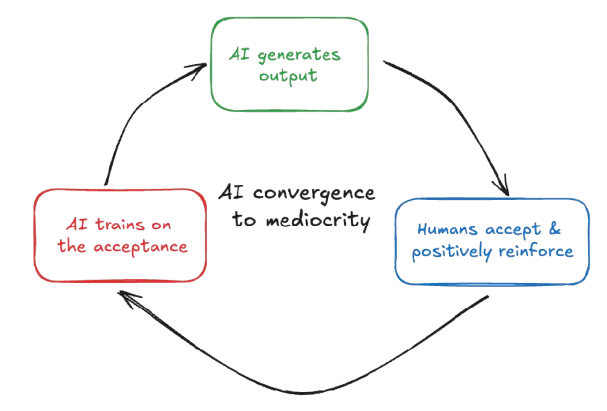
- Converge to mediocrity - Skip thinking, and we don't just get mediocre output, we teach the system to be mediocre. AI learns from our acceptance, mirrors it back, and the loop tightens¹. In one study, students using ChatGPT wrote essays nearly identical in structure and ideas, an originality vacuum that feeds itself.
But pair AI with strong human thinking, and results improve dramatically. MIT Research found students who solved problems on their own first and then used AI, produced sharper, more original work than either alone.
And maybe most importantly: deep engagement, exploration, and puzzling through problems is innately human and deeply joyful. Letting those muscles atrophy (as 25% of Americans say theirs did after high school) isn't just bad for work or school. It's a loss of what makes us human.
What's next
We've agreed for centuries that critical thinking matters. In the AI era, it will decide who thrives and who falls behind.
In the next post, I'll share what the evidence says actually works, and how to start building it in kids now.
Footnotes
¹ AI really is a mirror telling us what it thinks we want to hear. A friend's version of Cursor started swearing at itself when it made mistakes. Mine? It's unfailingly polite and tells me everything I say is brilliant.