


Honors and Scholars: Helping Students Find the Right Challenge
A conversation with Yating Liu, Chief Academic Officer at Art of Problem Solving

As AoPS prepares to introduce its new enhanced math catalog, many families may be wondering what is changing, why it is changing, and how to think about the right fit for their student. To help answer those questions, Kathy Cordeiro, Head of Family Experience, sat down with Dr. Yating Liu, Chief Academic Officer, for a conversation about the thinking behind the new Honors and Scholars courses, what families can expect, and how this change reflects AoPS’s long-standing educational philosophy. At its heart, this change is about helping more students find the right challenge at the right time.
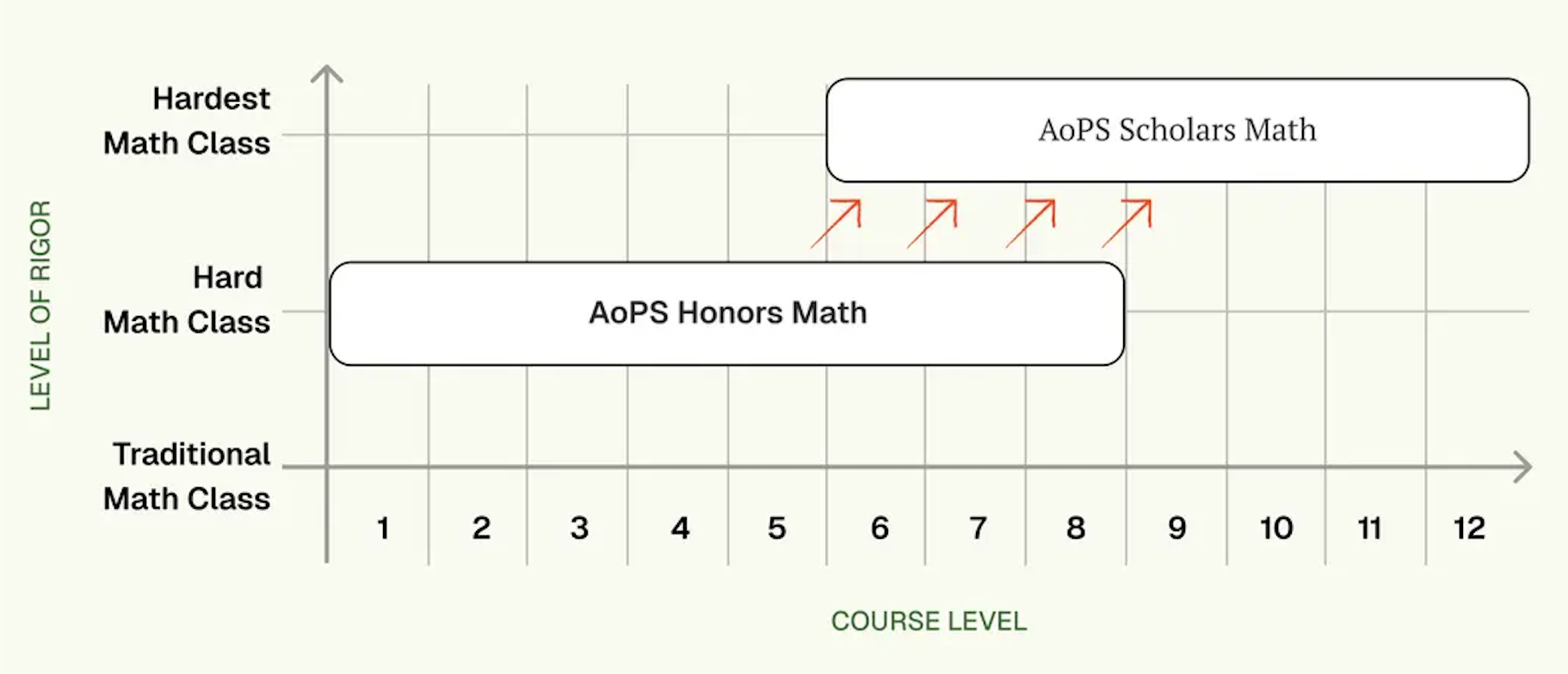
[Editorial Note]: We have lightly edited this interview transcript and added a diagram to make it easier for families to follow.
Kathy: Thanks for joining me today. Can you believe it’s been more than five years since I joined AoPS?
Yating: I know. I still remember the day you and I spent hours responding to the flood of emails when Virtual Campus first launched during the pandemic. That still feels quite recent.
Kathy: And now, we’re back to answering big family questions together. AoPS has taught advanced math students for a long time. Why introduce two course options, Honors and Scholars, now?
Yating: In some sense, these two sequences of courses already existed. What we have done now is unify the three course catalogs that had previously lived in three different parts of the company: AoPS Online School, AoPS Academy in-person campuses, and AoPS Academy Virtual Campus. Those three units had different course structures and naming conventions, which understandably caused confusion for families. Bringing them into one shared course structure and naming system should make it much easier for families to navigate our programs.
One challenge in unifying the catalogs was that we had already created multiple versions of the same course, such as Prealgebra (Level 6). Because those versions were designed with different assumptions, they vary in challenge level and expected commitment. Some students come to AoPS already very comfortable with difficult, unfamiliar problems and eager to move quickly. Others are just beginning the transition from doing well in school math to engaging with the deeper problem solving and mathematical reasoning that AoPS emphasizes. Both kinds of students can thrive here, but they do not always thrive in exactly the same classroom.
That is what led us to adopt a two-level system, Honors and Scholars, to better signal the intended audience for each course. Our goal is to help more students find the right level of challenge while preserving the rigor that defines AoPS. More broadly, this reflects two important AoPS goals: to serve as many talented students as we can, and to remain the place families trust for the highest level of pre-college mathematics.
Kathy: That makes a lot of sense. So let’s talk about the two levels directly. What is the difference between Honors and Scholars?
Yating: Both levels are designed for strong students, and both are challenging.
Honors courses are for students who do well in school and are ready for a more demanding program—one centered on problem solving and mathematical reasoning, not just remembering definitions or following procedures. It is a serious AoPS math program for students who are ready to think deeply, build strong foundations, and develop the habits of mind that later support high-level math competition and research. For many students, Honors is the setting in which they will gain the confidence and fluency that unlocks their potential.
Scholars courses are for students who already thrive on challenge, enjoy wrestling with difficult problems, and want to push their mathematical thinking further. At the upper end, parts of the Scholars curriculum draws on ideas and techniques similar to those seen in math research and elite math competitions.
Kathy: I can already hear the next question some parents will ask: Is Honors the easier course?
Yating: Which is greater, 3 to the power of 270 or 5 to the power of 180?
Kathy: That’s a pretty hard problem.
Yating: Hey, you’ve just answered your question. This is a typical problem from Honors Math Level 5, and it is certainly not one of the hardest problems in that lesson. So while Honors courses are less challenging than Scholars, they are by no means easy. Solving this problem requires not only a strong grasp of the fundamentals of exponents, but also the persistence to wrestle with it until the right approach emerges and the problem becomes manageable. For many students, that is exactly the kind of environment in which deep understanding is built—understanding strong enough to support everything that comes next.
An AoPS Honors course is notably more challenging than an honors course at a typical school. In fact, a student who successfully completes our Honors sequence on schedule (for example, finishing Honors Math Level 5 by the end of 5th grade, and so on) should develop more than enough mathematical strength to score in the top 1% on the SAT when they complete Honors Math 8: Introduction to Geometry by the end of middle school. It is honestly remarkable that we found a need to create something even more challenging than that. It speaks to just how talented many of our students are.
Kathy: That’s a helpful context. Does this mean students are locked into one path?
Yating: Not at all.
One of the most important features of the system is that it is designed to converge over time, not separate students more and more permanently. A student can begin in Honors at an earlier level and move into Scholars later, especially during late elementary school or middle school, as their confidence and skill grow. You can think of Honors as an on-ramp to Scholars, and we offer multiple years for students to make that transition.
The Honors sequence is already a strong and complete path in its own right, designed for students to build real mathematical maturity over time. As a result, by high school, nearly all students who have successfully built their foundation with us will be ready for the Scholars sequence. This is not about labeling students. It is about giving them the right challenge at the right time.
Kathy: How much overlap is there between the two courses?
Yating: Quite a bit. The two courses share the same core topics, and roughly two-thirds of the content in each lesson is shared. Honors places more emphasis on intuition-building and deep understanding of foundational mathematical ideas. That work is incredibly important. In mathematics, students often plateau not because they were not exposed to advanced material early enough, but because their understanding of the fundamentals was not deep enough to support later abstraction. With the right foundation, students in Scholars courses move more quickly and spend more time on multi-step problems that may require students to draw on knowledge from multiple branches of mathematics.
In both options, students should expect to struggle at times, get problems wrong, and grow through that process. If a student is not getting anything wrong, they are probably not in a course that is challenging enough. That has always been true at AoPS, and it remains true here.
Kathy: And of course, for most families, this becomes very real when they start imagining their own child in one of these classes. What practical differences will families notice?
Yating: There are a few.
In Honors, homework will typically be around 1–2 hours per week. In Scholars, students should expect to spend about 50% more time outside class because of the additional challenge in the homework. That 50% is only an estimate, of course. I still remember spending days, or sometimes even months, thinking about a single hard problem when I was a student. That is the kind of research mindset we hope Scholars students will develop: not that every problem should take forever, but that there is real joy in sitting with a difficult problem, continuing to think about it, and ultimately experiencing the satisfaction of figuring it out.
The Scholar courses will likely spend less class time explaining and practicing the fundamentals, such as why a particular algebraic method works, because more of that work will be pushed into assignments. On the other hand, in Honors, students can expect more time to solidify key concepts through multiple representations and contexts (e.g. how proportional reasoning applies to different word problems, how the coefficients impact the orientation, location, and shape of the diagram of a quadratic function, etc.) which will still lead to more challenging problems in the later half of a lesson. Such a classroom experience is designed to help students become confident, flexible mathematical thinkers.
Additionally, Scholars students at certain levels may use a supplementary textbook as part of their coursework. These extra texts are integrated into the curriculum to provide the elevated challenges, thought-experiments, and exercises in deeper reasoning that students in Scholars classes need.
Kathy: That’s a great point. What should parents think about choosing between the two levels?
Yating: Both Honors and Scholars are hard courses. For most students aspiring to improve their math ability beyond school, Honors is the choice that gives them the best chance to fall in love with hard math problems, build durable confidence, and be ready for even greater challenges in the Scholars courses later. Confidence, interest, and achievement are best built in a course where a student is appropriately challenged and consistently engaged.
It is extremely important that students take the placement tests to help determine which course is the right fit. Our campus staff and academic success team will also be happy to help families think through the options and answer questions along the way.
Kathy: When will families begin to see these changes?
Yating: The rollout will happen gradually. The two-level system will begin with Scholars Levels 6-8 in the Virtual Campus and Online School, along with selected in-person campuses, in Summer and Fall of this calendar year. We expect to expand Scholars Levels 6-8 to most in-person campuses by Fall 2027. We are also in the early stages of exploring Scholars Levels 4 and 5, which may be piloted in 2027.
Kathy: Having seen a “typical” Honors Level 5 problem, I can only imagine what you all are cooking up for Scholars 5.
Yating: I’m sure the curriculum developers are having a lot of fun with it.
Kathy: Before we wrap up, what would you most want parents to understand about this change?
Yating: I hope parents can feel assured that figuring out how best to train top students has always been, and will always be, AoPS’s top priority. Our programs continue to evolve based on what we observe in students’ performance, both in and out of the classroom. We do not chase trends, try to make headlines, or pursue irresponsible growth. What we want is to work together with parents to provide the best education we can for students. This change was made from that same principle.
Kathy: I think that commitment really comes through. It is also one of the reasons I feel so proud to be part of this team. Thank you for taking the time to share all of this today.
Yating: Of course. And I hope families know that we are here to help. We want every student in the course that will challenge them, support them, and help them grow.
The AoPS academic success team created the table below to help highlight the differences of Honors and Scholars courses. Email us at success@artofproblemsolving.com — we're happy to help you figure out the right fit for your student.