


I wrote this series about a year ago, prior to joining Art of Problem Solving as the VP of Beast Academy. At the time, I was working full time on my passion project, Puzz, creating critical thinking games for kids. There’s probably a reason AoPS feels like coming home! A year later, even with a new role and unprecedented evolution in what AI is capable of, my overall theses still feel relevant. However, with even more scrutiny on AI and screen time (hello, Toy Story 5, and screen time bans in schools) revisiting and sharing this series felt timely and important.
The goal of this series is to share my point of view around what matters most while raising kids in the age of AI, and what we as parents might do about it.
Part 1: The building blocks of critical thinking
From internet kids to AI natives
50% of K-12 students were already using ChatGPT weekly two years ago. More than 70% of teens have tried AI companions; nearly half used them regularly. Much like the internet in the 90s, we’ve moved beyond edge cases to the first AI-native generation.
My seven-year-old is one of them. Last Christmas, she created a present for her grandparents by using ChatGPT to write and illustrate an original book about her and her brother. When she has a question, she doesn't wait or wonder. She knows she can ask AI and get a good answer in seconds.
It's magical, but also unsettling. AI has made good answers cheap, fast, and abundant. The skills traditionally prioritized in schools (calculation, recall, even writing) are the ones AI now does better. Case in point: in 2023, GPT-4 scored a 1410 on the SATs, ahead of 94% of students.
So what's left for our kids? After 10+ years building education technology, I can't predict what jobs will exist when my kids are adults. But if machines own answers, my guess is the scarce human skill is critical thinking: the ability to ask the right questions, weigh options, and use good judgement to decide what matters.
What's coming in this series
Over the next few posts, I'll break down what critical thinking really is (and isn't), why it's always mattered but matters more now, and why it's so hard to teach. I'll end with research-based tactics parents can use today to help kids grow into big thinkers who remain relevant in the AI era.
One thing to note is that definitions vary broadly. AoPS’s definition of problem solving is what I define as critical thinking. To make that distinction clear, I’ll refer to “problem solving” as “traditional” problem solving during these posts.
What is critical thinking, and why traditional problem solving is not enough
Critical thinking vs. traditional problem solving
The term "critical thinking" isn't new, but there's no single definition. Over a century ago, John Dewey called it "active, persistent, and careful consideration" of what we believe and why¹. Fifty years later, Robert Ennis, defined it as "reasonable reflective thinking focused on deciding what to believe or do"².
Strip away the jargon and it comes down to this: critical thinking isn't about getting answers, it's about contextualizing and questioning them. It's the difference between blindly following a recipe vs. knowing whether and how to adjust for dietary restrictions, available ingredients, and personal tastes.
By contrast, traditional problem solving - what many gifted programs focus on - is narrower. Richard Mayer defined it as "cognitive processing directed at achieving a goal"³. That's about efficiency; reaching the right solution as quickly as possible.
In other words, traditional problem solving is just one slice of critical thinking. It's about getting an answer. Critical thinking is about the process of getting the best answer in the context of the bigger picture.
Components of critical thinking
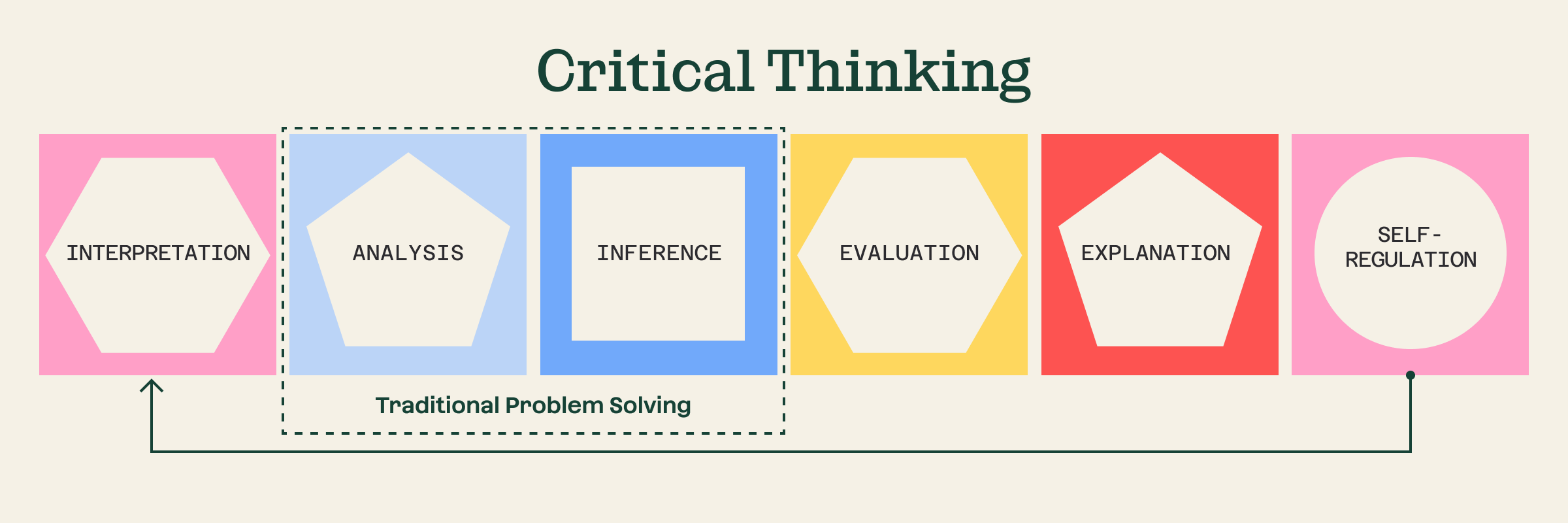
Researchers view critical thinking as a set of interrelated skills, not a single one. In a landmark 1990 study, Facione broke it into 6 parts:
- Interpretation: Figuring out what something means in context
- Analysis: Breaking down arguments and evidence
- Inference: Forming hypotheses and drawing sound conclusions
- Evaluation: Judging credibility, logic, and strength of information
- Explanation: Clearly articulating reasoning
- Self-regulation: Checking your own thinking
Critical thinking is the cycle of asking good questions, testing answers, and checking assumptions.
So what?
AI is already a world-class problem solver in the traditional sense. It even earned a gold medal at the International Math Olympiad, on par with the top 70 students globally.
But AI doesn't evaluate its own reasoning. It doesn't stop to ask: Did I miss something? Does this even make sense in this context?
I saw this firsthand as I was writing this article last year. I asked an AI article-summarizer to synthesize a piece it couldn't access. Instead of admitting it didn't know, it fabricated a completely false summary. Actual fake news, delivered with confidence.
Now imagine your kid trusting answers like that in higher stakes scenarios. That's why evaluation and self-regulation matter. That's why I predict these to be the important skills of the future.
As the team said in a previous post: "while AI excels at following prescribed lists and executing commands (even when trained on human-generated data), humans thrive in their ability to reason, make connections across fields, pivot when necessary, and solve novel problems."
These human abilities are where the opportunities of the future lie. But we aren't preparing kids for it. Schools are still teaching kids to get answers – the thing AI already outperforms us at. If we keep focusing on memorization, execution, and even traditional problem solving, we risk raising a generation with infinite AI-generated solutions at their fingertips, but no ability to judge which ones are right, relevant or even real.
Hasn't critical thinking always mattered? What's kept us from teaching it well? That's what I'll explore in the next post.
References
¹ Dewey, J. (1933). How we think. Boston, MA: D.C. Heath.
² Ennis, R. H. (2015). Critical thinking: A streamlined conception.
³ Mayer, R. E. (1992). Thinking, problem solving, cognition (2nd ed.). New York: W. H. Freeman.