


Knowing, Understanding, and Beyond
Part 2: Division
If you already read Part 1, you know what we’re talking about when we say ‘beyond.’ The visual below encapsulates the premise of this series:
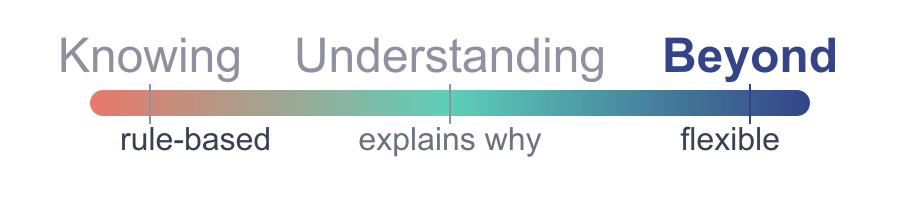
We're going to explore the different feelings we have along this spectrum through concrete examples.
So let’s jump right into our next example: long division. When most of us learn long division, it feels like a ritual of steps to perform without knowing why, so this makes it a great topic to look for the beyond.
Knowing
You know the long division algorithm. It always works. You don't need to know why it works; you just execute the steps. If something goes wrong, you probably won’t notice. It feels mechanical and rigid.
Understanding
You have some insight into why the algorithm works based on place value and the distributive property. This gives you more flexibility within the algorithm, and you can recover when you lose your place. But you're still essentially following the same procedure every time and not adapting depending on the situation. It feels less mechanical than ‘knowing,’ but still rigid.
Beyond
You stop blindly following the algorithm and start reshaping the problem into something you know is simple for you.
Let’s see these feelings in action on some problems.
Example 1: A bakery has 792 cookies and packs 4 cookies per box. How many boxes do they need?
Knowing
With 792 cookies and 4 cookies per box, this is a division problem of 792 ÷ 4. Depending on what school you went to or what country you grew up in, the notation may vary, but your algorithm will look more or less like this:
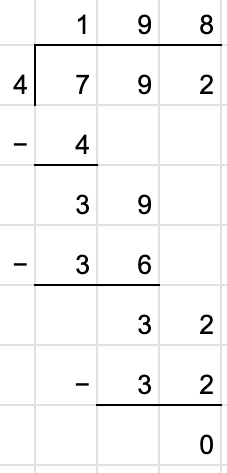
There is a meditative pleasure to the repetition of the steps, but they feel arbitrary. Why do we carry down the next digit as we go? What is subtraction doing in the middle of our division problem? Sure, we got the right answer of 198, but getting the correct answer isn’t the only goal of learning.
Understanding
With some understanding, you have a grasp of what the long division algorithm is really doing. We break down the number we are dividing (792) into chunks. Then we divide each of those chunks by the number we are dividing by (4).
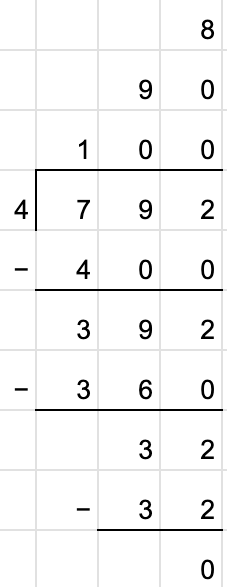
We can even use whatever chunks we want, which gives us some flexibility. For example, you might break 792 into 400+200+100+80+12 and go from there. However, even with the extra understanding and flexibility, this approach can feel like a slog.
Beyond
We can use a little wishful thinking. We know the bakery made 792 cookies. If only the bakery had baked 8 more cookies, for a total of 800, then they would need 800 ÷ 4 = 200 boxes. Then we just have to take away the extra cookies, which fit into 2 boxes, to get our final answer of 198 boxes.
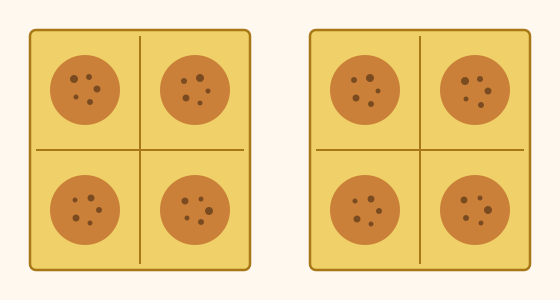
With some practice, you can even do this kind of ‘beyond’ solution in your head comfortably. The main point is that numbers are flexible, and we can choose to represent them in ways that work better for our given situation. (And you should always bake more cookies!)
Alright, that problem worked out nicely because 792 happened to be close to 800. But numbers won’t always cooperate like this. Let’s check out a different example where we can use a different kind of flexibility.
Example 2: A school is going on a field trip. There are 315 students. Each bus can take 45 students. How many buses are needed?
Knowing
Again, we have a division problem: 315 ÷ 45. Let’s try setting up the standard algorithm:
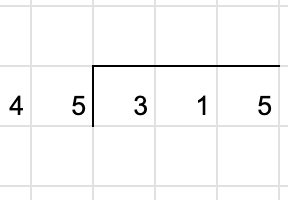
Great, now we start: 45 doesn’t go evenly into 3. Okay, next digit. 45 doesn’t go evenly into 31. Fine, next digit. 45 into 315…wait, you’re telling me to solve 315 ÷ 45, the first step of the algorithm is to do 315 ÷ 45?! I’m throwing my pencil across the room at this point.
Understanding
At this level, we can use our basic idea of chunks to make progress toward computing 315 ÷ 45. For example, we can take a chunk of 90 out of 315 as a first step, since 90 is a simple multiple of 45:
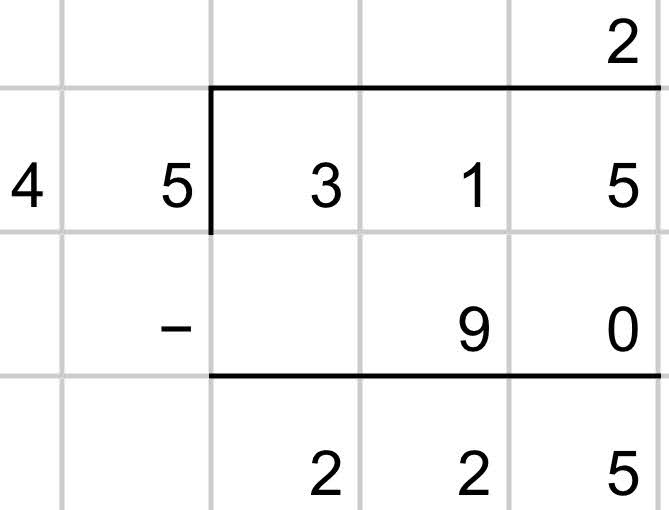
If we continue in this way, we’ll solve the problem without having to throw our pencil anywhere. But try doing this in your head with 315 students milling around a parking lot.
Beyond
315 ÷ 45 is a little hard to think about with mental math, but those 5s will turn into 0s if we double both terms. And doubling both terms in a division problem will not affect the answer! It would be like having twice as many students but also having double-decker buses.
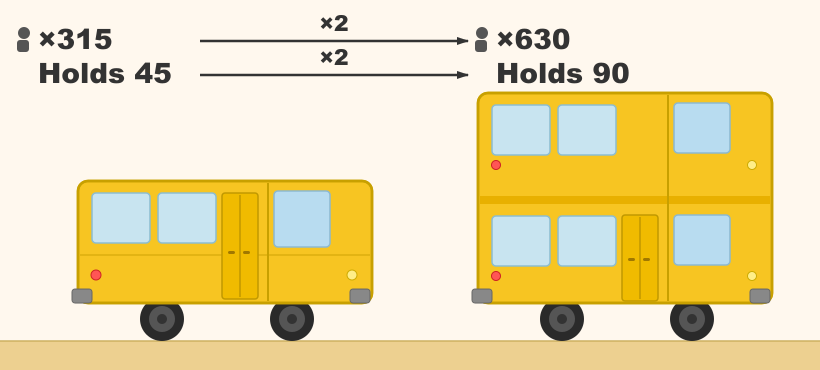
So we can compute 630 ÷ 90 instead. That’s a lot easier since it’s the same as 63 ÷ 9 = 7. No long division required—you can do it in your head! (One weird trick to solve any division problem: just double both numbers! Does it always help? Absolutely not—try it with 44 students per bus and you get 630 ÷ 88, which is harder, not easier. But that's the point: we’re not looking for a universal trick; we’re poking at the specific problem we have.)
We saw in the first example that numbers can be flexible, but computations themselves are flexible too! If you don’t like the division problem you’re given, try scaling it to land somewhere that’s easier for you.
Now with a couple examples under our belt, let’s finish off with a challenge. Mull it over yourself first, and see what kinds of flexible ideas you have!
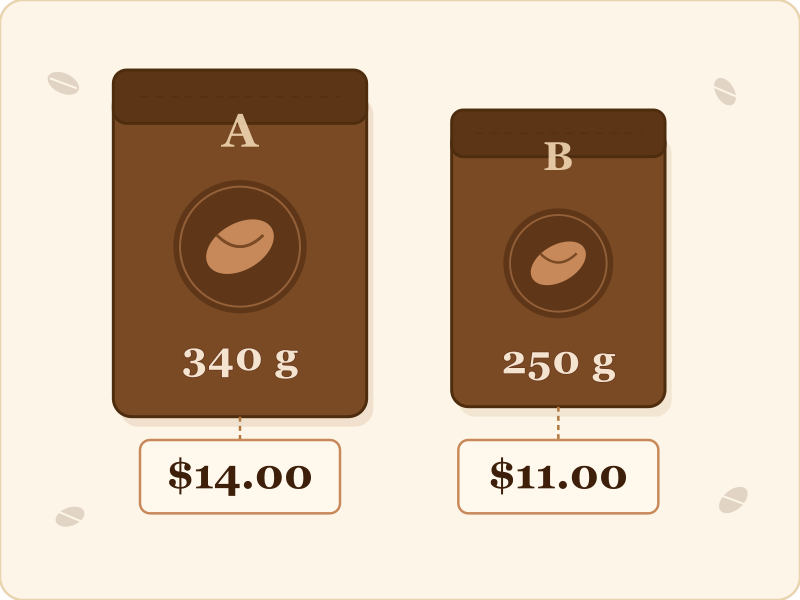
Example 3: The same coffee is sold in two different bag sizes. Which size is a better deal?
Knowing
You have a sense that you need to divide some numbers here. But do you divide 340 by 14, or 14 by 340? And when you compare the result to bag B, do you pick the bigger result or the smaller result? It’s starting to feel overwhelming. Maybe you just flip a coin and call it a day.
Understanding
At this level, you have a sense of the concept of unit cost: you want to compare dollars per gram for both bags. But to get dollars per gram, we’re gonna have to compute 14 ÷ 340 and 11 ÷ 250. That looks painful! We need some more flexible ideas here to make progress.
Beyond
It’s hard to compare the bags immediately because they are different sizes. But we can use our imagination, and some math, to make them more comparable. Why don’t we scale both of the bags up to a convenient larger bag—say, about 1000g?
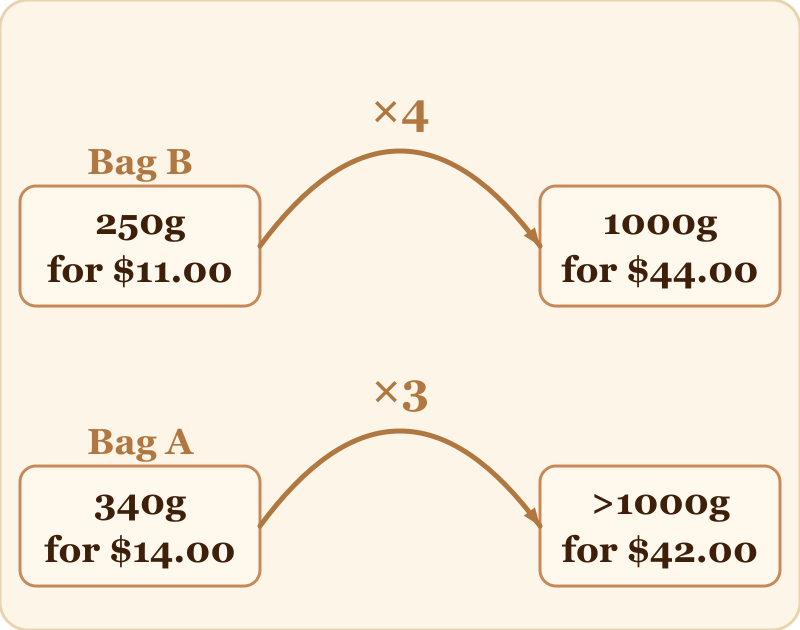
Works like a charm! We can see that Bag A gives us more coffee for less money than Bag B.
The point of what we just did wasn’t to get 198 cookie boxes or 7 buses or a slightly cheaper coffee. What we’re really doing here is practicing our vision: we want to see problems as malleable. In our examples, we saw that a division problem isn’t just a fixed thing to decode; it’s a relationship you can play with. There won’t always be a shortcut, but the hunt for one is more than half the fun, and even when you don’t find it, you always come away seeing more.
Are you ready to go "beyond" with fractions? Read Part 3!
About the Author: Dr. Aaron Demby Jones is an educator, musician, and visual artist with a background in both mathematics and music. He spent several years at Art of Problem Solving as Curriculum Developer and Product Director, and has taught at Johns Hopkins CTY and HCSSiM. Learn more about his work at www.studiodemby.com.
The views expressed in this guest post are those of the author and do not necessarily represent those of Art of Problem Solving.