


This past summer, as I perused my books, I rediscovered The End of Average by Todd Rose. I received a copy of his book in 2015 at Harvard’s Data Wise Leadership Institute, and I had the pleasure of hearing him speak during the conference. His work illuminates how “averages” exist in concept but don’t actually appear in our day-to-day reality, and how metrics such as brain mapping, standard personality tests like Myers-Briggs, and benchmarks of “normal” child development might each represent a vast oversimplification of our complex and diverse humanity. Highlighting the standard mapping of the brain as an example, Rose comments that “the driving assumption of this method is that the Average Brain represents the normal, typical brain, while each individual brain represents a variant of this normal brain” (Rose, 2015, p. 20), however; when individual brains are actually imaged and studied, “not only was each person’s brain different from the average, they were all different from one another” (p. 21).
The Statistical Trap
Rose’s findings contain a call for us to reflect on the education we seek to provide for our kids. Over the past several years, there have been movements to standardize education to measure student success. However, Rose points out that these movements are based on an inherently faulty premise: that kids are supposed to meet specific benchmarks at specific times. As a veteran educator with 20+ years of experience in a variety of schools and roles, I have also fallen into the statistical trap, wanting my students to advance at a certain rate, or to display their growth as numbers against an arbitrary baseline. The statistical trap diminishes these kids as individuals and stipulates that their progress should always follow a single, “average” path to an equally singular idea of success. Yet as any of us who work with kids know, their growth is seldom linear, they rarely exhibit “average” traits, and their goals are not identical. Instead, kids need to be placed at the center of their learning and given the fullest opportunity possible to explore at their pace and to lead their own discovery.
Putting Kids at the Center
Today, I am fortunate to work for AoPS Academy, an organization whose recent rebrand reinforces the idea that kids are the trailblazers of their own educational journey. While others pay lip service to “disruption” or “transformation” or “21st-century learning” or “student-centered learning” (statements with little or vague meaning), AoPS builds a place that is entirely authentic and singular. AoPS places kids at the center of their logo and has refocused their messaging on a simple idea: “We don’t teach kids what to think. We teach them how.” While this statement is bold, AoPS backs it up with a curriculum that gives students the freedom to critique, question, and explore until they find something wonderful.
Instead of focusing on metrics or short-term benchmarks, AoPS strives to provide kids what they need now and in the future: freedom to grow, explore the unknown, fail, try again, and take on the impossible. At our Academy, we create a community for all curious minds by showcasing the uniqueness of each kid and encouraging them to find joy in the act of thinking deeply. We help them broaden their horizons far beyond the scores on a standardized test or grades on a transcript; we give them room to discover what their minds can do.
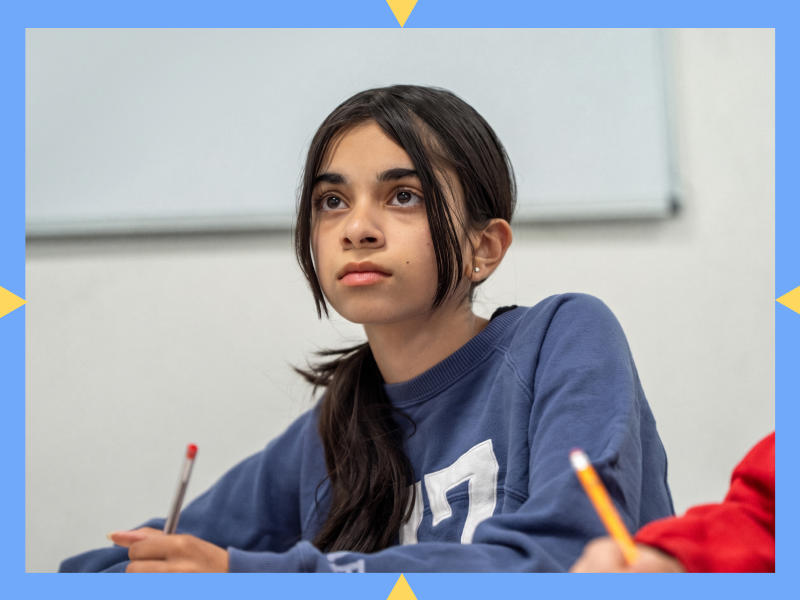
In a world focused on instant answers and measuring averages, our in-person classrooms are committed to providing kids with the freedom and depth to chart their own paths. We invite you to see how our educators interact with kids as they explore who they are and independently develop the tools to ask profound questions and provide their own nuanced answers. As the world moves forward, there is nothing more important than giving kids the gift of logic that lasts forever.