


Knowing, Understanding, and Beyond
Part 3: Forbidden Fractions
If you remember a warning about fractions, it’s probably this one:
'When you add fractions, you can’t just add the tops and add the bottoms.'
No reason given, just…don’t. We’ve been using this series to explore what it looks and feels like to go beyond knowing and understanding (see Part 1 and Part 2 for more). A forbidden rule with no explanation is the perfect place to dig deeper.
Knowing
Your teacher told you not to add fractions by adding across on top and bottom. You store that away in your list of ‘things I can’t do’. You’re not really sure why you can’t do this thing. Your math anxiety increases by 1 point.
Understanding
You have a grasp of fractions as parts of the same whole:
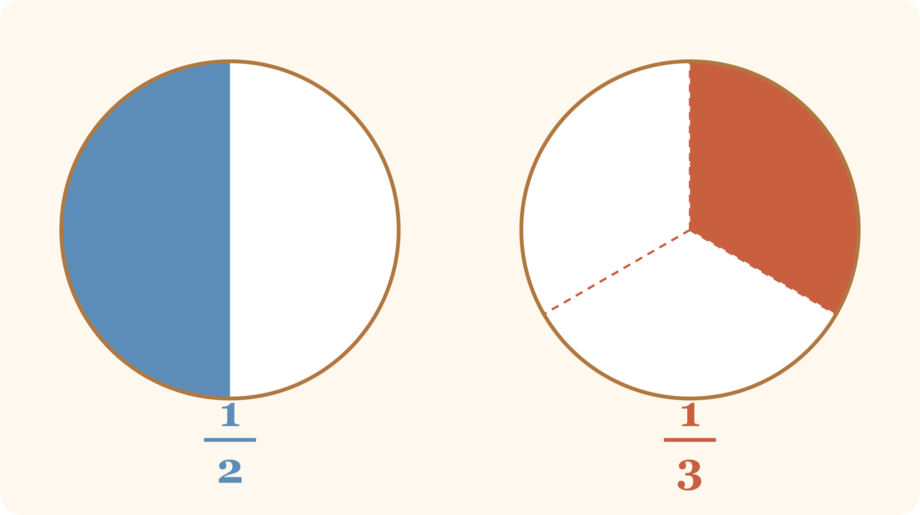
Then you can understand why when adding \(\frac{1}{2}+\frac{1}{3}\), it doesn’t make sense to add 1+1 across on the top, because the two parts you are adding are not the same size part!
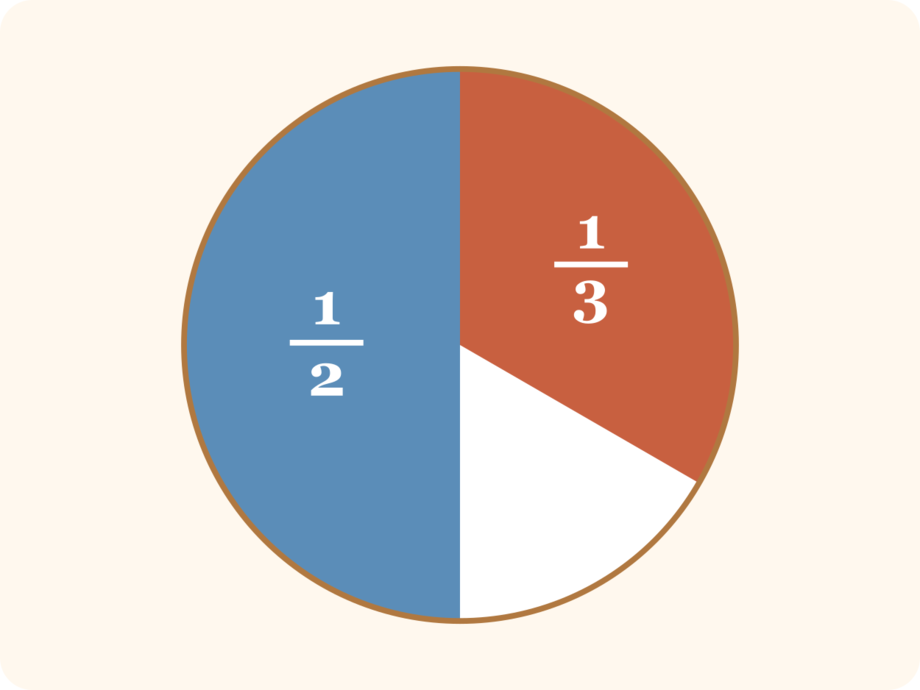
Instead, it takes some extra detective work to figure out what fraction of the whole the combined shaded region of \(\frac{1}{2}+\frac{1}{3}\) represents.
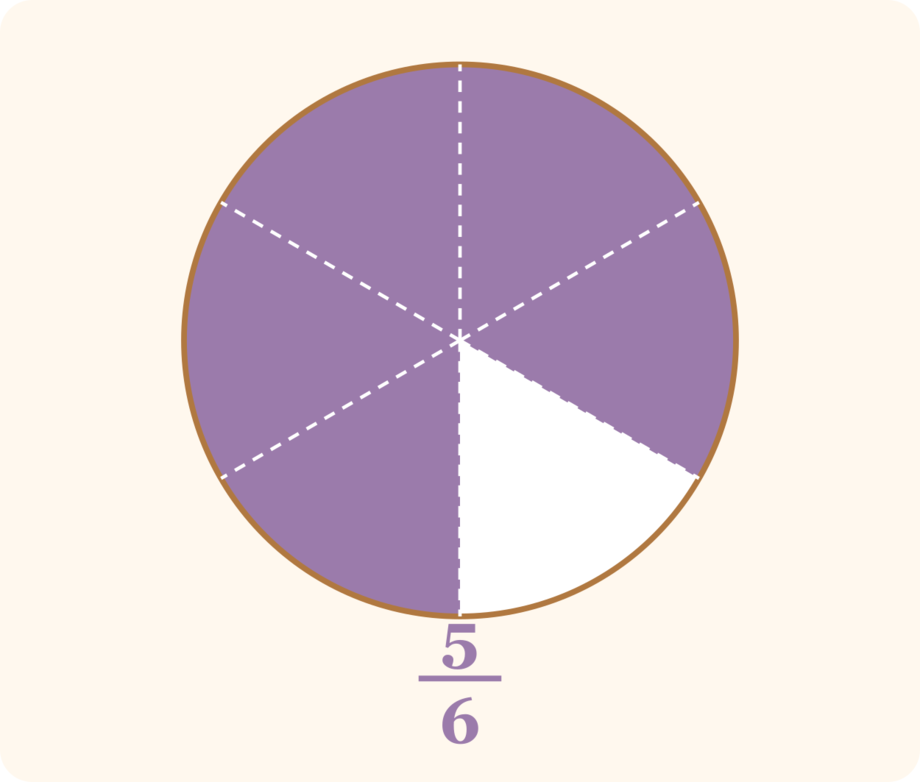
With this understanding, you confidently reject the idea of adding the tops and bottoms of fractions and sleep easy at night.
Beyond
It’s harder to sleep at night, because you have a nagging feeling that adding the tops and bottoms of fractions must have some meaning. It’s kind of like Jeopardy—sure, we know \(\frac{1+1}{2+3}\) is not the answer to the question "What is \(\frac{1}{2} + \frac{1}{3}?\)”, but maybe it’s the answer to a different question! So we reframe our perspective. Instead of asking ‘Is this allowed?’, we ask "What does this represent?" This is a different way to relate to math: rules tell you what you can and cannot do, but models just tell you what’s happening.
Our adventure today has three acts. Acts 1 and 2 lay the groundwork; Act 3 is the payoff.
Act 1: A Warm-up
In order to answer the question "What does this represent?", we need a model. I’m feeling a little thirsty, so let’s go with lemonade. Here’s a diagram to get started.
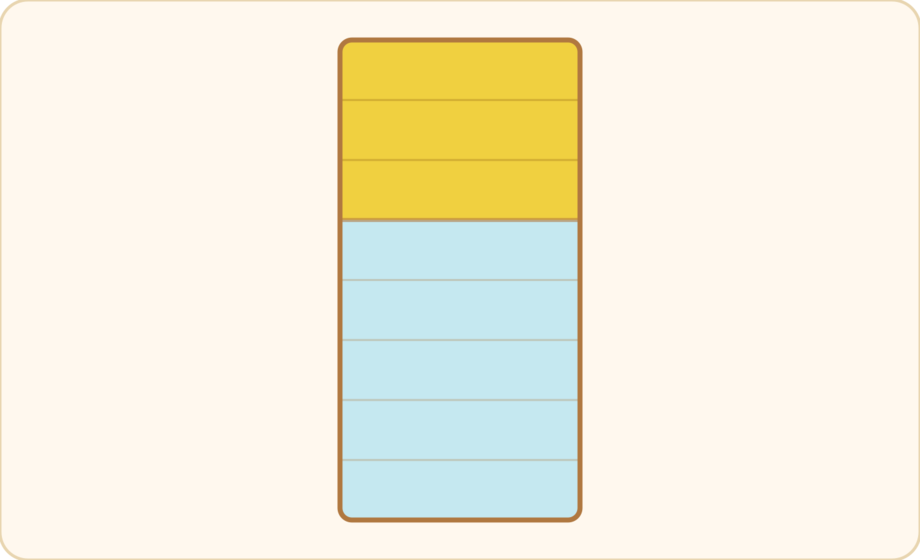
Where do the fractions come in? Well, we want to describe how lemony our lemonade is. A natural way to measure this is using the fraction:
Lemon juice parts / Total parts
Let’s call this fraction lemon power. So in our diagram, the lemon power is 3/8. A maximum power lemonade would have lemon power of 8/8 = 1 (all lemon!).
Suppose we want our lemonade to taste more lemony. What do we need to do? Add more lemon juice! Say we add 2 more parts of lemon juice to our existing lemonade. What can we say about the new lemon power?
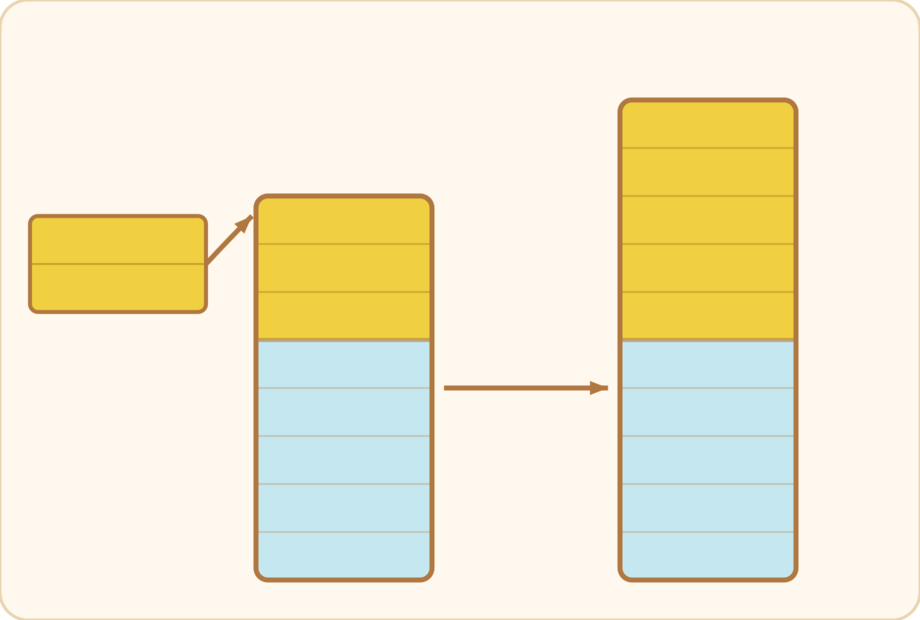
Well, lemon power is defined as Lemon juice parts / Total parts. How many lemon juice parts are in the new lemonade? It would be \(3+2 = 5\), right? And how many total parts are in the new lemonade? It would be \(8+2 = 10\). So our new lemon power is
$$\frac{3+2}{8+2} = \frac{5}{10}$$
So adding 2 parts of lemon juice increased our lemon power from 3/8 up to 5/10. This isn’t too surprising, since we know from experience that adding pure lemon juice to our mixture will make it taste lemonier. The more parts we add, the closer we get to the lemon singularity.
.gif)
Furthermore, we’ve found a model that is compatible with adding things on the top and bottom of a fraction. It works nicely because, unlike in our pie model, we’re keeping all the parts the same size rather than keeping the same whole.
Adding pure lemon juice is fun, and I’m excited to see what the lemon singularity has in store for us, but it also makes me wonder: what can we add that preserves the same taste?
Act 2: A Key Idea
Adding pure lemon will just make our lemonade lemonier. Similarly, adding pure water would make our lemonade waterier. So whatever we add would have to be some mix. But which mix?
That’s right: we need to add another batch of lemonade with the same lemon power!
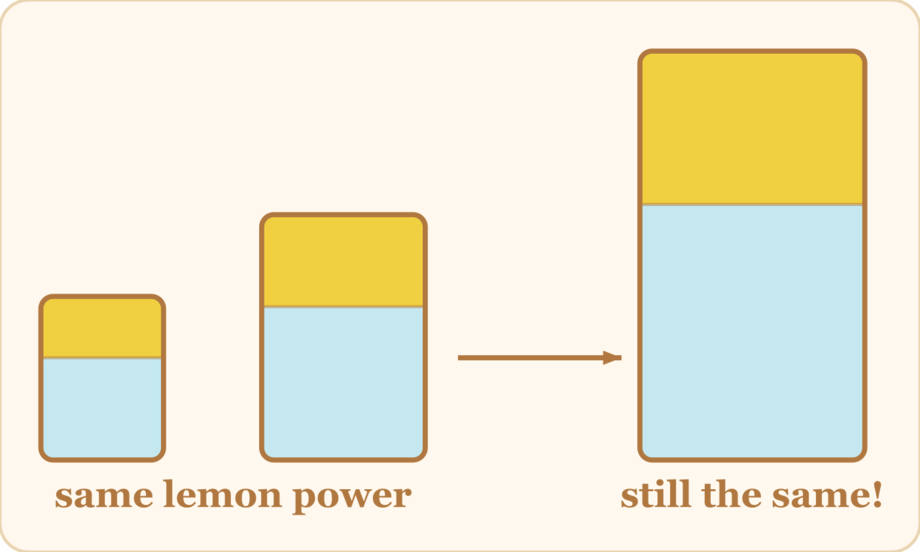
This is the kind of thing that seems simple in lemonade land but is tricky to write down in math. Let’s give it a go, though. If our first lemonade has a lemon power of 3/8, as long as our second lemonade also has a lemon power of 3/8, (say, 30/80), we can mix them together to make a bigger lemonade with the same 3/8 lemon power.
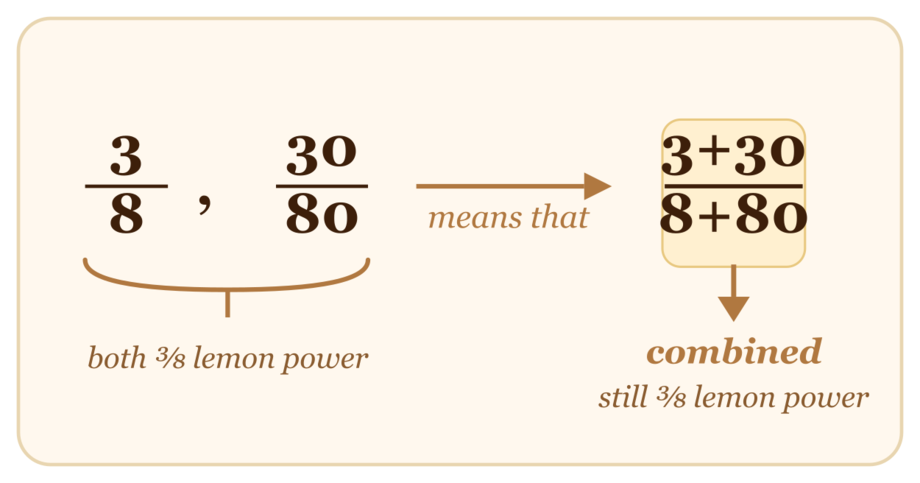
Okay. Enough playing around. Let’s be bold and try to understand the thing we came here to do: what does combining two fractions by adding the tops and bottoms actually represent?
Act 3: The Forbidden Rule, Revisited
We know that \(\frac{3+7}{8+11}\) is not the answer to the question “what is \(\frac{3}{8}+\frac{7}{11}\)?” But now, we’re finally ready to figure out what question it is the answer to! With our lemonade model, this is simple: we start with two pitchers of lemonade, each with different lemon powers. Crucially, we use the same-size parts in each of them.
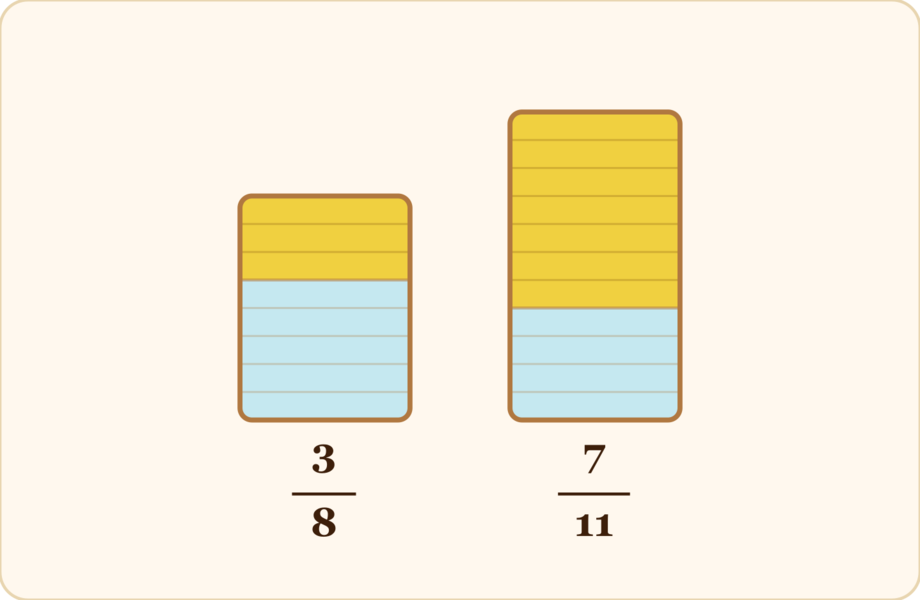
What happens if we combine these two lemonades into one big lemonade?
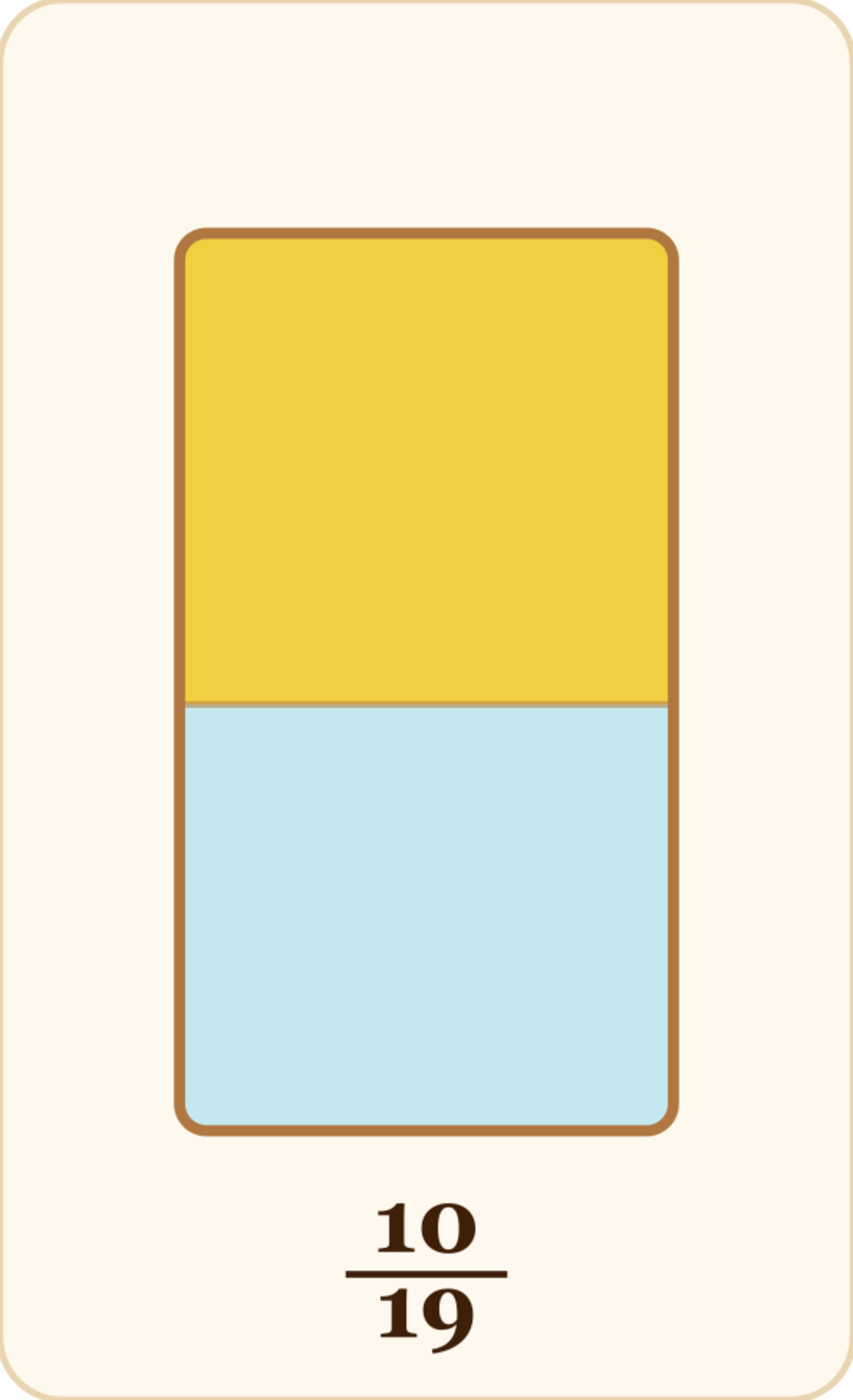
Since all the parts are the same size across lemonades, the new mixed lemonade has \(3+7=10\) parts of lemon juice and 8+11=19 total parts. So it has a \(\frac{3+7}{8+11}=\frac{10}{19}\) lemon power.
(Wait, why do the parts have to be the same size? Imagine a 3/8 lemonade where the parts are cups and a 7/11 lemonade where the parts are buckets; we can’t just mix them together and say the new mixture has 3+7 parts lemon juice because the parts are completely different sizes!)
Aha! So the right question to ask is not “what is \(\frac{3}{8}+\frac{7}{11}\)?”, but rather “what is the lemon power of combining a 3/8 lemonade and a 7/11 lemonade, each with the same size parts?” Since that’s a lot of words, let’s come up with a term for it: we can call it the lemon blend1 of two fractions, and write it as \(\frac{3}{8}🍋\frac{7}{11}\).
Intuitively, the 3/8 lemonade is less lemony and the 7/11 lemonade is more lemony, so when we mix them together, the overall mixture will be an in-between lemoniness.
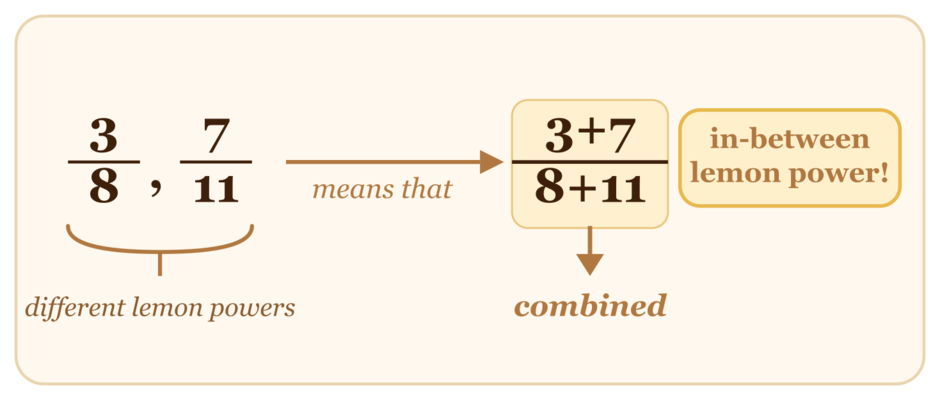
Since the 7/11 lemonade has a bigger volume than the 3/8 lemonade, we can also intuit that the lemon blend will be closer to the 7/11 strength than the 3/8 strength. This is clear when we read off the lemon powers on our trusty lem-o-meter:
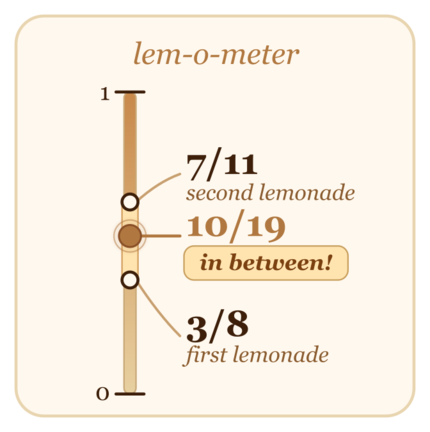
The 7/11 lemon power was an arbitrary example, but we can generalize the pattern: the lemon blend of 3/8 with a totally random mixture c/d, making \(\frac{3+c}{8+d}\), will result in a lemonade with a lemon power somewhere in between 3/8 and c/d.
So what was the point of all this lemonade math? We started out with a forbidden rule: don’t add fractions by adding their tops and adding their bottoms. We ended up with a rich understanding of what exactly adding the tops and bottoms of fractions can mean. The rule told us what to avoid; the model told us what actually happens. That's the 'beyond' move: stop asking 'Is this allowed?' and start asking 'What does this represent?'
1 Mathematicians have settled for the drier name ‘mediant,’ if you want to talk about this concept to someone else without sounding like a lemon-loving lunatic.
About the Author: Dr. Aaron Demby Jones is an educator, musician, and visual artist with a background in both mathematics and music. He spent several years at Art of Problem Solving as Curriculum Developer and Product Director, and has taught at Johns Hopkins CTY and HCSSiM. Learn more about his work at www.studiodemby.com.
The views expressed in this guest post are those of the author and do not necessarily represent those of Art of Problem Solving.